
AI is killing our planet and our ability to think - Let’s talk about it
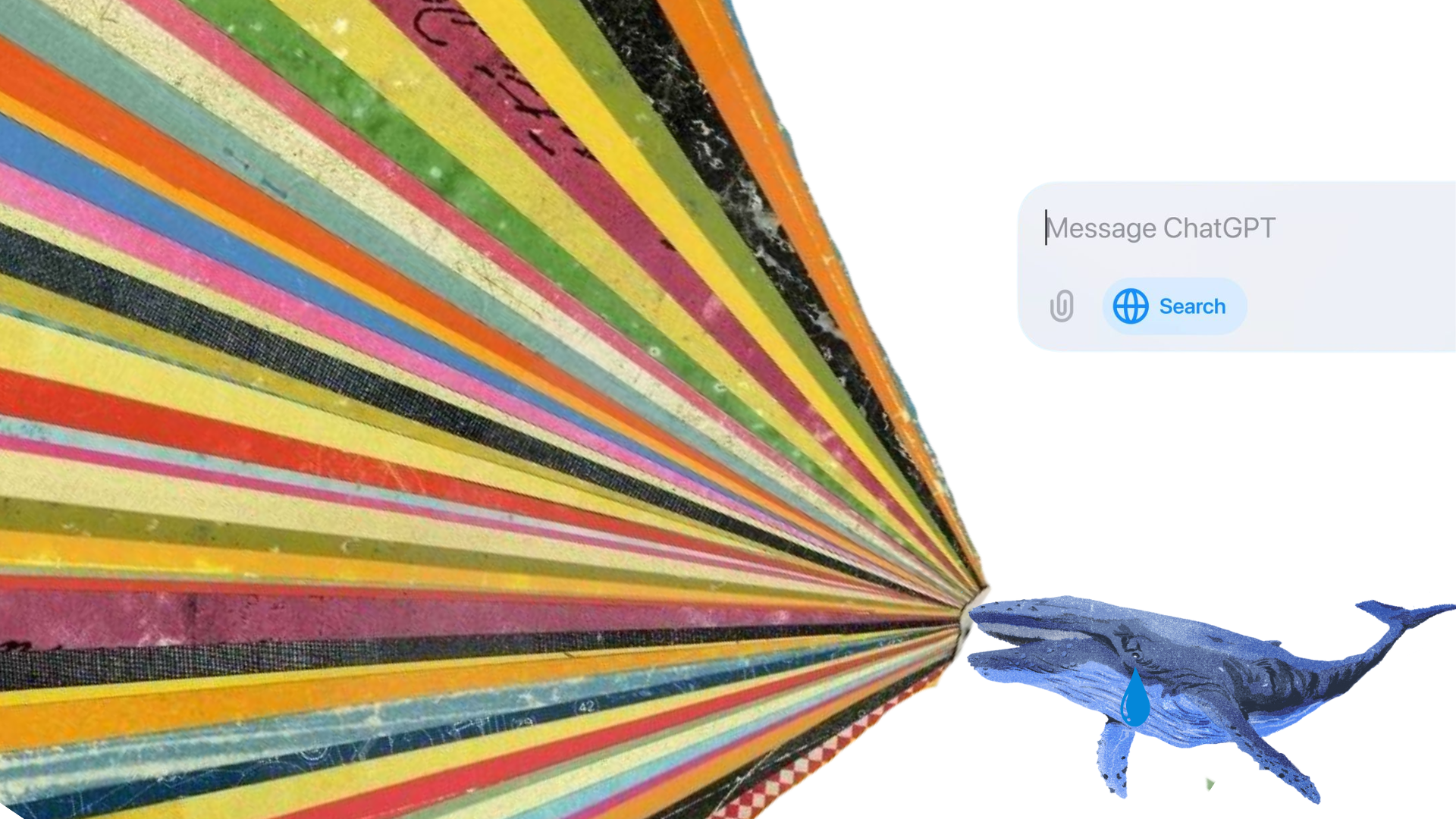
By the time you finish reading this article, an artificial intelligence system somewhere will have generated thousands of images, answered millions of questions, and quietly consumed enough energy to power entire households for days. AI has become the miracle tool of the modern age, writing our emails, unfortunately creating our art, choosing our music (Spotify DJ), predicting our behaviour, and even driving our cars. Yet beneath its sleek design and viral success stories lies a growing cost we must confront: AI is accelerating environmental destruction while subtly eroding our ability to think and create for ourselves.
Some probably imagine digital technology as something light and harmless, but the reality is far heavier. AI runs on vast data centres: warehouse-sized buildings packed with servers that never sleep, pulling enormous amounts of electricity and water just to stay cool and functioning. In fact, researchers have found that training a single large AI model can produce as much carbon pollution as several cars over the course of their entire lives. And with tech companies racing to outdo one another with ever more powerful systems, these models are being built by the thousands, quietly driving energy use higher and higher.
Data centres already account for roughly one to two per cent of global electricity use, a figure expected to rise sharply as AI becomes embedded in nearly every industry. In many regions facing water shortages, companies use millions of gallons of freshwater annually just to cool overheated servers. Communities are asked to conserve while tech infrastructure quietly drains resources at an industrial scale. The environmental burden of AI is largely invisible to users scrolling on their phones, but its footprint is rapidly becoming one of the fastest-growing sources of emissions in the technology sector.
Alongside the strain on the planet comes a quieter transformation of the human mind. AI is increasingly doing the cognitive work we once did ourselves - writing, researching, summarising, planning, creating. Psychologists describe this as cognitive offloading: when humans rely so heavily on tools that memory, critical thinking, and problem-solving skills begin to weaken. Just as constant GPS use has reduced our natural sense of direction, constant reliance on AI risks dulling our ability to think deeply, wrestle with complexity, and generate original ideas.
Convenience feels harmless, even helpful, but its long-term effects are profound. When answers arrive instantly, patience for reflection fades. When machines produce polished content in seconds, the messy process of thinking is bypassed. We become curators of machine output rather than creators of thought. Over time, this reshapes how societies learn, innovate, and question. A population that rarely practices critical thinking becomes easier to influence, easier to mislead, and less equipped to challenge power.
Perhaps the most intimate space AI is reshaping is art, the very arena where humanity has always processed emotion, resistance, memory, and meaning. For centuries, art existed not simply as a product but as a process: a slow unfolding of thought, struggle, failure, and lived experience. It is in this friction that voice is formed. AI disrupts that relationship entirely.
Today, images, music and poetry are generated in seconds. What once took years of practice and personal evolution can now be simulated instantly. While often celebrated as democratising creativity, this shift risks flattening it. When creation becomes effortless, the depth behind it quietly disappears. The labour that once gave art its emotional gravity is replaced by algorithmic efficiency.
AI does not create from experience. It does not feel grief, joy, injustice, desire, or hope. It learns by absorbing enormous volumes of human-made work and recombining patterns that perform well statistically. In doing so, it mirrors culture back to us - stripped of context, struggle, and intention. The result is art that is visually impressive yet emotionally hollow, polished yet detached.
More concerning is how this reshapes what audiences come to expect from creativity itself. Speed becomes the standard. Volume replaces depth. Artists are pressured to produce constantly to remain visible in algorithm-driven economies. When machines can generate endless content, human creators risk being undervalued, underpaid, and pushed into burnout. Art shifts from expression to output.
Originality erodes as well. Because AI is trained on existing work, it naturally gravitates toward dominant styles and familiar aesthetics. This reinforces sameness. Experimental voices and marginalised perspectives struggle to surface in a landscape increasingly optimised for what is recognisable and clickable. Culture becomes a loop - endlessly remixing itself rather than evolving.
Authorship blurs. Artists have already discovered their work embedded inside AI-generated images and music without consent or credit. Lifetimes of creative labour are quietly absorbed into training datasets that fuel billion-dollar technologies, while the original creators receive nothing in return. It is an extraction in digital form - not of land or labour, but of imagination.
Perhaps most dangerously, AI is reshaping how young generations relate to creativity. If the instinct becomes to generate rather than to learn, struggle, and explore, the slow cultivation of artistic voice may disappear. Creativity turns into consumption, and expression becomes automation.
Technology has always evolved alongside art - from photography to digital design - but those tools expanded human expression rather than replacing it. AI, when positioned as the creator rather than the assistant, crosses a fundamental line. It moves from supporting imagination to substituting it.
Technology companies frame this transformation as inevitable progress. But progress without responsibility has always carried hidden costs. Industrialisation poisoned rivers and skies before regulations intervened. Today, the rapidity of the advancement of AI has now surpassed ethics, leading to a force that environmental protections and education can not keep up with. The environmental damage is externalised onto the planet, the cognitive consequences onto society, while profits remain concentrated among a powerful few.
This is not an argument to abandon innovation. AI holds potential to improve medicine, accessibility, scientific research, and climate modelling. But its expansion must be guided by accountability rather than unchecked growth. Transparent reporting of environmental impact, renewable-powered infrastructure, ethical limits on deployment, and education that prioritises human thinking over automation are essential.
Most importantly, we must protect our ability to think and create. Tools should extend human intelligence, not replace it. The danger of AI is not that machines will become too smart - it is that humans will become passive.
The real question is not whether AI will shape the future. It already is. The question is whether that future will prioritise convenience over consciousness and efficiency over sustainability.
If we continue embracing smarter tools without questioning their cost, we may wake up in a world that is faster and louder, yet poorer in creativity, critical thought, and planetary health. Progress should elevate humanity - not quietly replace it.
References
Strubell, E., Ganesh, A., & McCallum, A. (2019). Energy and Policy Considerations for Deep Learning in NLP. University of Massachusetts Amherst.
MIT Technology Review (2022). The Climate Cost of Training Large AI Models.
International Energy Agency (IEA). Data Centres and Global Energy Consumption Reports.
Li, P. et al. (2023). Making AI Less Thirsty: Uncovering the Water Footprint of AI Models. University of California, Riverside.
Carr, N. (2010). The Shallows: What the Internet Is Doing to Our Brains. W.W. Norton & Company.
Nature Climate Change (2022). Carbon Emissions of Machine Learning Training and Deployment.
U.S. Copyright Office (2023). AI and Intellectual Property Issues in Creative Works.