
Climate Justice, Diplomacy, and the Politics of Comoros - In Conversation with Meriam Mravili
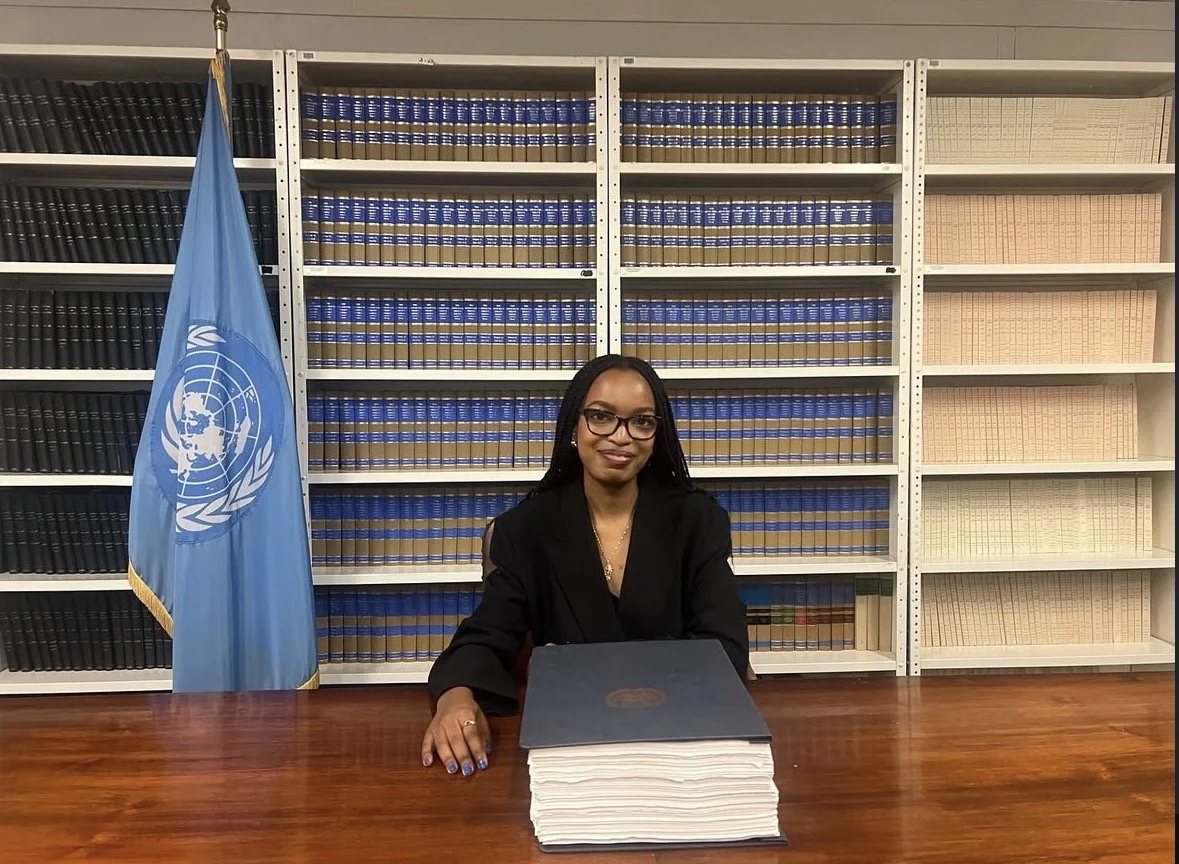
At just 27 years old, Meriam Mravili represents a new generation of international lawyers shaping global policy from both the negotiating table and the field. Born in Tunisia and half Comorian, Mravili currently works as a Policy Analyst with the United Nations Development Programme (UNDP) in Sierra Leone, where she provides legal and policy support across a wide portfolio that includes social development, youth employment, women’s empowerment, governance, economic growth, and climate vulnerability.
Her career trajectory reflects both intention and adaptability. “One day I am in a meeting with stakeholders like the World Bank or the Ministry of Justice, the next day I am drafting policy briefs on the human rights situation in the country,” she explains. While broad in scope, her work is deeply rooted in impact - supporting governments directly and translating international norms into national policy.
Although Mravili always knew she wanted to be a lawyer, her path to international law was not linear. She completed her undergraduate studies in Sociology in the United States at Canisius University, where exposure to gender inequality, climate justice, and systemic injustice shaped her professional direction. “From that degree, I knew that I wanted to work somehow in human rights,” she says.
A pivotal moment came during an internship with the International Organisation for Migration (IOM) in Cameroon. Witnessing the tangible impact of UN field operations on migrant communities solidified her commitment to international human rights law. Growing up across multiple countries and being raised by a father who worked for humanitarian NGOs—and later the FAO—also played a defining role. “I didn’t see myself just working for a law firm. I wanted to work with people from all over the world,” she reflects.
Diplomacy at the heart of the United Nations
Mravili later served as a Legal Advisor to the Permanent Mission of Comoros to the United Nations, where she worked primarily with the Third Committee of the UN General Assembly, which addresses human rights, social development, and cultural issues. Her role was highly diplomatic, involving negotiations with delegates from around the world and the defence of Comoros’ legal and political priorities.
“We are part of the African Group, the Arab Group, and the Francophone Group,” she explains, highlighting the complex positioning of Comoros within multilateral negotiations. At just 25 years old, she was often the sole legal advisor in rooms filled with senior diplomats. Despite the challenges, she describes the experience as formative, offering insight into global power dynamics and the realities of representation for small states.
Climate change and small island states
One of the defining aspects of Mravili’s work is climate justice, particularly for small island developing states (SIDS) like Comoros. While not formally trained as an environmental lawyer, she worked as a legal consultant with the African Union, supporting a case before the International Tribunal for the Law of the Sea (ITLOS) in Hamburg.
The case, brought collectively by Comoros and other African island states such as Cape Verde and São Tomé and Príncipe, focused on the disproportionate impact of climate change on countries that contribute almost nothing to global emissions. “We face sea level rise, coastal erosion, and environmental degradation, yet we contribute almost nothing to global emissions,” Mravili notes. This imbalance, she argues, makes climate change not only an environmental issue but a legal and moral one.
For Comoros, climate vulnerability is inseparable from political and economic stability. Rising sea levels threaten livelihoods, food security, and infrastructure, compounding existing governance and development challenges. Mravili’s work underscores how climate injustice reinforces political marginalisation for small island states within the international system.
Political representation and systemic challenges
Beyond climate, Mravili is outspoken about the lack of geographical representation at the UN, particularly for countries like Comoros. “There are very, very few of us,” she says, pointing to the structural barriers that limit participation from smaller and less-resourced states.
As a young African Muslim woman, she also encountered microaggressions and scepticism early in her career. Yet she emphasises that diversity within the UN - and particularly within African country offices—has been a source of strength rather than exclusion. “Most people in my office look like me,” she says of her current role in Sierra Leone, highlighting the importance of representation in leadership and decision-making.
Choosing impact over prestige
Mravili also worked with the UN Office of Legal Affairs (OLA) in New York, where she worked on highly technical legal matters, including contracts, UN internal justice, and questions of immunity and privilege. While prestigious, the experience clarified her priorities. “I felt like I was helping the United Nations, but not the people I wanted to help,” she explains.
This realisation led her away from headquarters-based legal work and toward field-based roles, where policy decisions have visible consequences for communities. It is a choice that reflects a broader critique of international governance structures that often privilege process over people.
Digital advocacy and influence
In parallel with her institutional work, Mravili has built a significant presence as a content creator, documenting her career in global legal affairs and mentoring early-career professionals. Her platforms have opened doors to speaking engagements at institutions such as Harvard and Cornell, and have expanded access to information about careers in international law.
“My social media helped me have opportunities I would not have had otherwise,” she says, noting that visibility and transparency are powerful tools for democratizing access to elite spaces.
Comoros at a crossroads
For Mravili, the political and climate crises facing Comoros are deeply personal. Meeting the President of Comoros and receiving recognition for her work was, she says, a moment of validation - both professionally and emotionally. “Having that validation meant the world to me,” she reflects.
As Comoros navigates climate vulnerability, economic constraints, and limited political leverage on the global stage, voices like Mravili’s are increasingly critical. Her work illustrates how law, diplomacy, and climate justice intersect - and how young professionals from marginalised states are reshaping global governance from within.
References
United Nations Development Programme (UNDP), Country Programmes and Climate Adaptation Initiatives
International Tribunal for the Law of the Sea (ITLOS), Advisory Proceedings on Climate Change and the Law of the Sea
United Nations General Assembly, Third Committee (Social, Humanitarian and Cultural)
African Union, Legal Affairs and Environmental Governance Initiatives
International Organisation for Migration (IOM), Migration and Human Rights Frameworks