
Radical Optimism - Why we ALL NEED TO BE A LITTLE MORE DUA LIPA
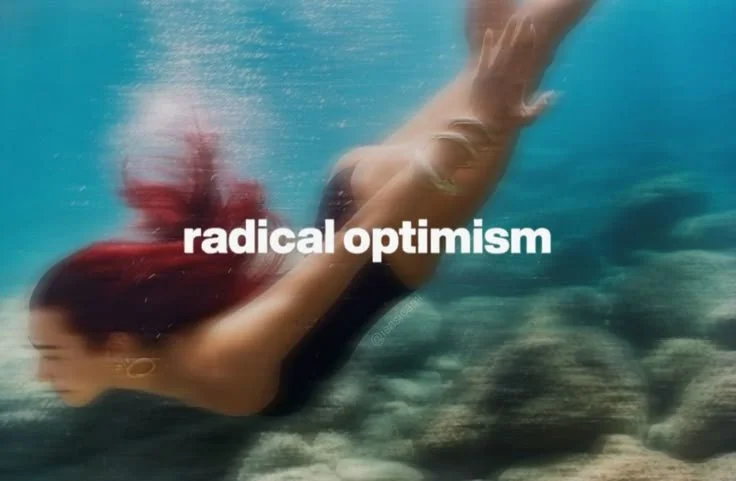
For a long time, we assumed the brain functioned like a camera, passively recording what happens to us. Now we know that it behaves more like a forecast system. Modern neuroscience shows the brain is constantly predicting what will happen next, filtering reality through expectations built from past experience. These predictions influence what we notice, how we feel, and even how our body responds before events fully unfold. When we anticipate threats, stress systems activate early. When we anticipate reward or possibility, dopamine circuits engage in advance, making us more motivated, focused and emotionally resilient. Optimism, in other words, isn’t wishful thinking. It’s a prediction bias that changes physiology.
Studies led by neuroscientist Tali Sharot have demonstrated that optimistic expectations activate the brain’s reward centres even before positive outcomes occur. The body begins preparing for good things—mood lifts. Cognitive flexibility increases. Stress lowers. The nervous system becomes more adaptable.
Pessimism does the opposite. The brain narrows attention, amplifies threat perception, and strengthens anxiety loops. Over time, these loops become efficient. You don’t choose negativity; your brain just runs it faster. We process these limiting beliefs so naturally and so often that they solidify into fact in our minds. Which, on the flipside, reframes optimism from “positive thinking” into something closer to emotional engineering.
When Lipa began speaking about her album Radical Optimism, she described something surprisingly philosophical: that she believes what she writes tends to come true. Not in a mystical sense, but in a psychological one. She chooses to embed hope, joy, lightness, and resilience into her lyrics, and instinctively or deliberately, because she understands that language shapes emotional reality. This aligns perfectly with what we believe is the antidote to negativity and, in our opinion, also genius marketing.
When you repeatedly expose your brain to stories of resilience, growth, connection and joy, whether through music, thought patterns or language, you strengthen neural pathways associated with emotional regulation and reward. The brain learns to expect life to be workable, even when it’s hard, and when you expect life to be workable, you respond differently to obstacles.
Dua Lipa’s work doesn’t deny heartbreak, insecurity or struggle. It reframes them through momentum instead of stagnation. Her songs move, sonically and emotionally, which now brings us to the science of sound.
Music is not just entertainment. It’s vibration interacting with biology. Tempo, rhythm, frequency and harmony all affect heart rate, breathing patterns, hormone release and emotional state. Faster tempos tend to increase alertness and energy. Moderate rhythms can stabilise mood. Certain harmonic structures reliably stimulate pleasure responses in the brain.
Pop music, especially the kind Dua Lipa crafts, sits right in the physiological sweet spot of human movement and emotional uplift. Many of her songs hover around tempos that naturally sync with walking pace, light exercise and elevated heart rate. Your body interprets this as vitality.
Her earlier album Future Nostalgia practically functioned as a serotonin prescription during the lockdown years, not just because of lyrical genius, but because rhythm and frequency were engineered to energise the nervous system, which actually has a more significant effect than you might think. Sound doesn’t ask permission to influence mood. It bypasses logic and speaks directly to the body. Which is why a song can shift emotion faster than a rational thought ever could. It seems very obvious, but of course, it does have a deeper meaning; however, in brief, listening to sad music makes you sad, and listening to happy music makes you happy.
The self-talk experiment we’re all accidentally running
Every human being runs a private internal monologue all day long.
Most of us didn’t choose it. We inherited it from childhood experiences, social environments, criticism, comparison culture and past failures. And it tends to sound harsher than we’d ever speak to someone else.
The physical act of speaking out loud or of writing something down can shift something in our awareness; things that may be understood as normal or part of our everyday vernacular can sound horrible when said to another or even to ourselves in the mirror, rather than a passing thought in our head.
Things like, ‘you look ugly in that’ or ‘you’ll never be good enough to do that’ are expected of an ordinary person's thought process. It may seem counterproductive to say them out loud or write them down, as we would want to push them away or ignore them, but bringing your awareness to the limiting beliefs and confronting them is the first step.
Neurologically, these aren’t harmless thoughts. They activate the same stress circuits as external threats. The body releases cortisol. The brain narrows perspective. Emotional reactivity increases. Over time, these loops become automatic. You aren’t “bad at being positive”, your nervous system is just well-trained in self-criticism.
But here’s the hopeful part: when people consciously shift their internal language to kinder, more constructive realism, measurable changes occur in emotional regulation, the stress response, and motivation. Those subtle shifts reduce threat response and activate problem-solving networks, and our language becomes biological.
Which brings us back to the plant metaphor psychology keeps returning to for a reason.
Across developmental psychology, organisational research, and emotional neuroscience, one pattern repeats relentlessly: things that are nurtured tend to grow. Things that are attacked tend to shrink.
Children thrive when encouraged. Employees perform better under supportive leadership. Relationships flourish with kindness. Even plants subjected to gentle treatment grow more robustly than those in harsh environments.
Yet most of us run our inner world like an interrogation room. We try to bully ourselves into success, and the brain doesn’t respond well to that strategy. Harsh self-talk increases stress hormones, which impair learning, creativity and memory. Kind but honest self-talk lowers stress, improves focus and strengthens emotional resilience.
There’s a common critique of optimism that usually follows the lines of “it must be nice to be positive when the world is falling apart”. And yes, optimism alone doesn’t dismantle inequality, stop wars, or fix systemic problems. But pessimism has never fixed them either. What optimism does is preserve agency.
Sociocultural research shows that in communities under chronic stress, whether economic, political or social, narratives of hope often function as survival mechanisms. They don’t deny hardship. They prevent psychological collapse under it. When people believe improvement is possible, they engage. When they believe nothing will change, they disengage.
Radical optimism isn’t pretending everything is fine. It’s choosing interpretations that keep you psychologically alive enough to act. It’s the difference between “this is hard and pointless” and “this is hard and worth trying.” One shuts systems down. The other keeps them open.
Dua Lipa’s lifestyle, from creative expression to movement, travel, connection, and intentional joy, mirrors what psychological research consistently links to emotional well-being: engagement, novelty, social connection, physical activity and meaning-making.
She doesn’t write herself as a victim of heartbreak. She writes herself as someone who moves through it and beyond it. She doesn’t frame struggle as identity. She frames it as a moment in motion.
References
Sharot, T. (2011). The optimism bias. Current Biology.
Delgado, M. R. (2007). Reward-related responses in the human striatum. Annals of the New York Academy of Sciences.
Etkin, A. (2010). Emotional processing in anterior cingulate and medial prefrontal cortex. Trends in Cognitive Sciences.
Thoma, M. V., et al. (2013). The effect of music on the human stress response. PLOS ONE.
García-Argibay, M., et al. (2019). Binaural beat audio and brainwave entrainment. Neuroscience & Biobehavioral Reviews.
Taylor, S. E., et al. (2000). Psychological resources and health outcomes. American Psychologist.